


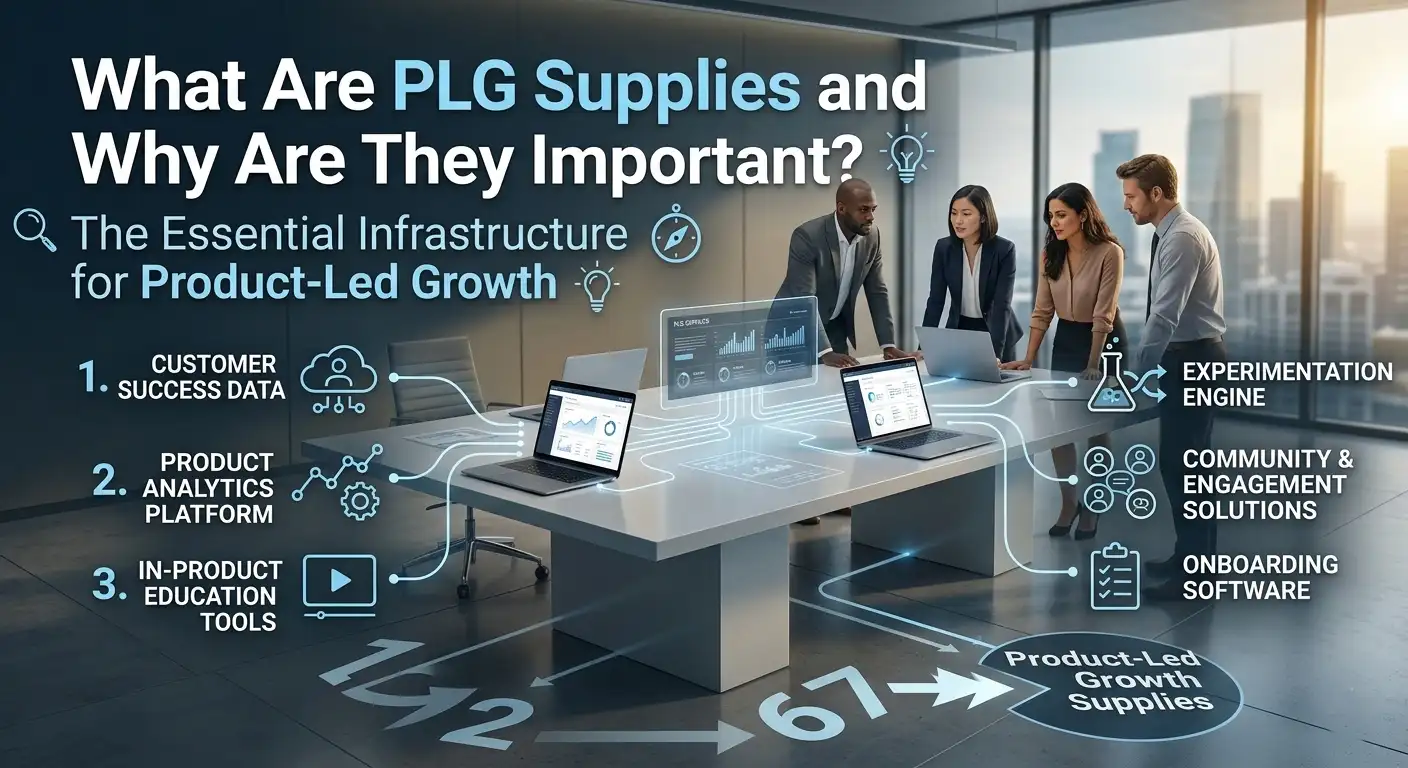
In SaaS, PLG stands for Product-Led Growth, a growth model where the product itself drives acquisition, conversion, retention, and expansion. OpenView, which popularized the term, defines PLG as a strategy where the product becomes the primary growth engine, while Productboard describes it as a go-to-market approach that relies on product usage rather than traditional sales-heavy motions.
With that in mind, PLG supplies are the tools, systems, and product assets that make a product-led strategy work in real life. It is a useful way for SaaS companies to describe the infrastructure behind PLG. We can include feedback loops, in-app guidance, product analytics, lifecycle automation, onboarding flows, data connections, and more. All these things work together to produce results.
What are PLG supplies?
At the simplest level, PLG supply is the set of resources that help users experience value quickly and keep progressing within the product without excessive human intervention. In a sales-led model, growth depends heavily on demos, follow-ups, and account executives. In a product-led model, the product has to do much more of that work itself. That means SaaS companies need systems that help users discover value, understand features, get unstuck, and reach meaningful milestones on their own.
Product analytics tools
Product analytics sits at the center of most PLG stacks because teams need to understand user behavior in detail. Product analytics helps you understand user insights, improve product experiences, and boost retention. In practice, this includes tracking activation events, measuring funnel drop-off, identifying retention drivers, and seeing which actions. Without that visibility, PLG becomes guesswork.
Onboarding and in-app guidance tools
Another major category of PLG supplies is onboarding and in-app guidance. ProductLed’s onboarding guidance emphasizes that users need to reach an “aha moment” and activation quickly, while Pendo’s in-app guidance resources focus on timely, contextual help inside the product. These tools include walkthroughs, checklists, tooltips, hotspots, and onboarding flows.
Feedback and research systems
You cannot produce results with PLG if your focus is only on ignoring sentiments. Measuring clips is not what PLG expects. Identifying users’ hesitance is essential, and it can be done through roadmap systems, customer research, and feedback tools. SaaS teams must identify essential improvements and address broken expectations.
Automation and integration layers
PLG supplies also include the systems that move data and trigger action.
In the modern world, SaaS companies need to work differently. They need to target the market with expansion of plays, product events, sales alerts, support follow-ups, in-app nudges, and power emails. Your product usage data should not be isolated. If it happens, offering an opportunity to respond rightly or personalize the journey becomes challenging.
When exploring Pendo and Amplitude, we know that data, analytics, and action must work coherently across the customer lifecycle.
Why are PLG supplies important?
PLG matters because it reduces time-to-value. In product-led businesses, the faster users experience a meaningful outcome, the more likely they are to stay engaged. When exploring one of the top onboarding guides, aha moments reduce churn risk and should be supported by guided experiences tailored to user goals.
They also improve activation and retention. The experts frame PLG around using the product to acquire, convert, and expand customers. However, it is essential to understand that it only works if users continue to find value after signing up.
PLG supplies are especially important for identifying Product-Qualified Leads (PQLs).
When defining PQLs, we got assistance from ProductLed. It means the prospects who become clients after experiencing product value. PLG works exceptionally well when product usage signals are more effective, and marketing activities yield fewer results. Using the right stack helps a lot in this regard, as behavior helps teams to spot buying intent without any obstacles. Some behaviors that drive buying intent include repeated use, hitting activation milestones multiple times, interest in premium features, and frequent collaboration with teams.
Expansion is another feature that PLG supports. Generic outbound messages do not work effectively, especially in upselling at product-led SaaS models. When exploring Pendo’s product-led retention and expansion guidance, we learn that feature-specific guidance, usage-based signals, and in-app prompts work better to encourage users to renew or upgrade the product after experiencing the product.
Ultimately, PLG supplies help decide better after careful observation of the product data. Through analytics, we learn what users like and how to do it. Feedback, suggestions, criticism, and reviews tell why users choose a specific product. With onboarding tools, we learn how to improve our processes. Through automation, we can get detailed analysis to improve the performance of our marketing, sales, customer success, and support teams. Therefore, PLG is considered the best way to develop a successful operating model.
How to choose the right PLG supplies
Start with your aha moment. ProductLed recommends identifying the point at which users first recognize the product’s value and designing onboarding around the milestones that lead to it. If your team does not know what that moment is, adding more tools will not solve the problem.
Next, map the activation journey. Look at what a successful user does in the first session, first week, and first month. Then choose supplies that help users reach those milestones faster—whether that is event tracking, onboarding checklists, in-app messaging, or lifecycle automation.
Keep the stack connected. A disconnected PLG stack creates blind spots. Your coordination with prospects should be smart, which is possible only when you share as much information as possible through communication systems, feedback, onboarding, and analytics.
Most importantly, the outcomes must be measured intelligently. Do not rely on vanity metrics much, as they do not drive growth. On the other hand, PQL creation, expansion signals, feature adoption, retention, and track activation work. Connecting business outcomes with product behavior makes Product-Led companies successful.
Common mistakes SaaS teams make with PLG supplies
Defining the user journey is the most significant task. However, many people try to buy many tools before defining the user’s journey. It can hit you back badly. Another mistake people make is insisting that users come on board just once. However, they must not do so and ensure there is an ongoing adoption process.
Another mistake we make is not building workflows and starting to collect product data. In many cases, it can be negative. PLG guidance in the current world works in the opposite direction. Now, it is essential to focus on user value. With that, user guides are tailored to the context, product documentation is provided, and iteration is based on feedback, suggestions, and behavior to produce results.
Final Thoughts
PLG supplies are the foundation of Product-Led Growth in SaaS. They include tools and systems that help users discover value, move through onboarding, adopt key features, signal buying intent, and expand naturally over time. A SaaS company does not become product-led just because it offers a free trial or freemium plan. It becomes product-led when the product experience, data systems, and growth workflows all work together to drive efficient, scalable growth.
FAQs
What does PLG stand for in SaaS?
PLG stands for Product-Led Growth, a model where the product itself drives acquisition, conversion, retention, and expansion.
What are PLG supplies?
In a SaaS context, PLG supplies are the tools, systems, and product assets that support a product-led strategy, such as analytics, onboarding, in-app guidance, feedback systems, and automation. This is a practical framing based on the core components emphasized across current PLG resources.
Why are PLG supplies important?
They help users reach value faster, improve activation and retention, identify Product-Qualified Leads, and create more scalable expansion paths inside the product.
What tools are usually included in a PLG stack?
Most PLG stacks include product analytics, onboarding, and in-app guidance tools, feedback systems, and workflow or data integration layers.
How do you choose the right PLG supplies?
There are a few steps to choosing the most suitable PLG supplies. Here are these steps:
- Identification of an aha moment
- Activation journey mapping
- Choose tools to ensure less friction.
- Ensuring stack connectivity with measurable business outcomes.
