


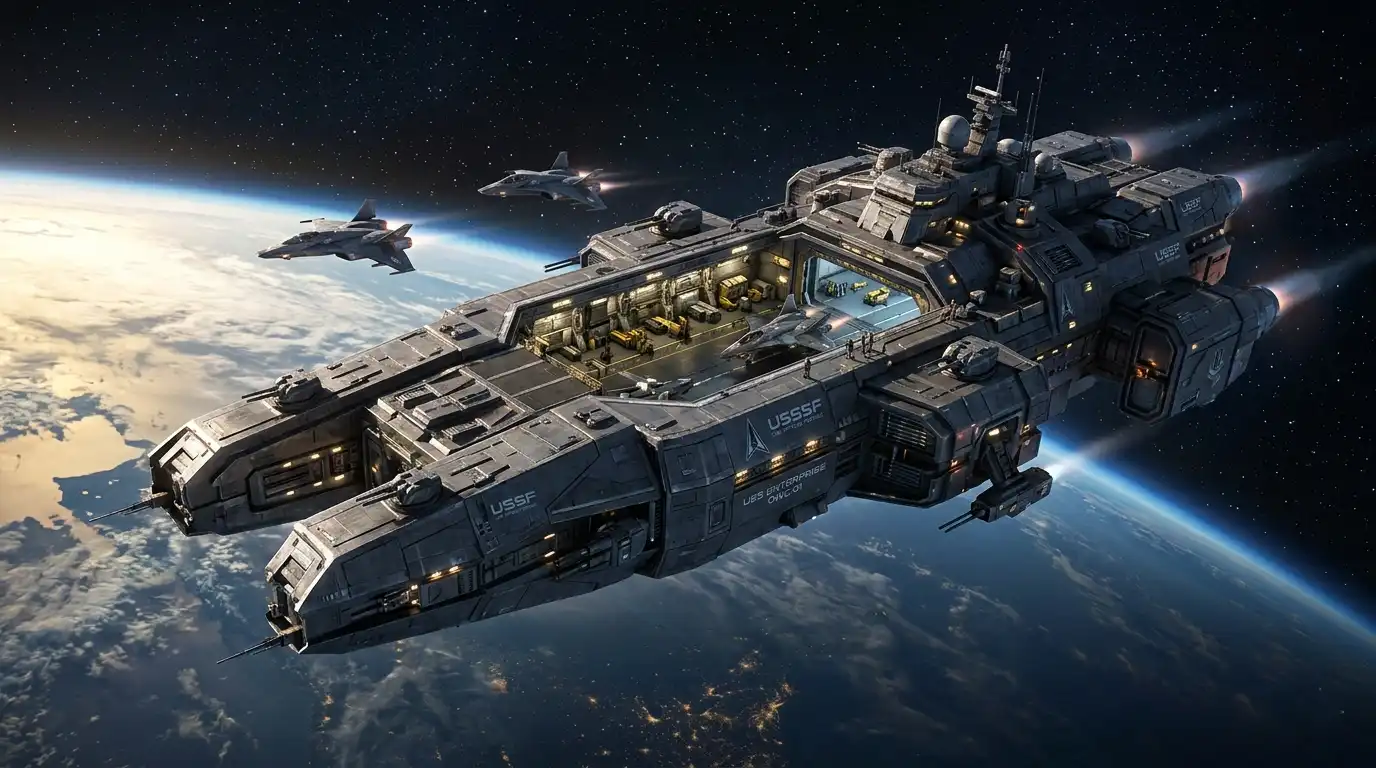
The idea of a “space force orbital warship carrier” sounds like something pulled straight out of science fiction, a massive military vessel patrolling Earth’s orbit, launching spacecraft like fighter jets.
But reality is both more grounded and more important.
An orbital aircraft carrier is a new concept that the US Space Force has been exploring. Another name for it is an orbital carrier.
Factually, terminology varies in its approach. However, aerospace and defense circles are giving attention to this idea. According to these terminologies, it is a platform in orbit that plays a very important role in managing multiple space vehicles, operating them, and, if required, deploying them on demand.
This isn’t about building a Star Wars-style battleship. It’s about solving a very real problem: how to operate effectively in a contested, fast-changing space environment where satellites are vulnerable, and response time matters more than ever.
In this article, we’ll break down:
- What a Space Force orbital warship carrier actually is
- How it would work in practice
- Why the concept is emerging now
- What challenges does it face
- and whether it could reshape the future of space operations
Why Everyone Is Talking About the Space Force Orbital Carrier
The surge in interest around orbital carriers didn’t happen by accident.
It stems largely from a SpaceWERX-backed initiative supporting the aerospace company Gravitics to develop an “Orbital Carrier” prototype.
According to the details available, tens of millions of dollars are required to invest in this project. This project is designed to be pre-positioned in orbit to demonstrate its capabilities and deployed rapidly when required.
This reflects a broader shift in military thinking.
For decades, space operations relied heavily on:
- Large, expensive satellites
- Long launch preparation timelines
- Limited redundancy
That model worked when space was relatively uncontested.
But today, space is increasingly:
- Congested
- Competitive
- And potentially hostile
Nations are developing capabilities such as:
- Anti-satellite weapons (ASATs)
- Electronic warfare systems
- Cyber interference targeting satellites
In this environment, waiting weeks or months to launch a replacement satellite is no longer acceptable.
That’s where the orbital carrier concept comes in.
What Is a Space Force Orbital Warship Carrier, Exactly?
Let’s clear up the biggest misconception first.
Despite the dramatic name, a space force orbital warship carrier is not a traditional warship.
It is better understood as:
An orbital platform, which is pre-positioned, and its responsibility to store and deploy maneuverable satellites and spacecraft whenever and wherever required.
Think of it as:
- A space-based staging hub
- A deployment platform in orbit
- Or a logistics node for space operations
The “aircraft carrier” analogy is useful, but only to a point.
What it shares with an aircraft carrier:
- Carries multiple deployable units
- Enables rapid deployment
- Acts as a forward-positioned asset
What it does NOT do:
- It doesn’t launch fighter jets
- It isn’t necessarily crewed
- It’s not designed for direct combat
In fact, current concepts suggest it would likely be:
- Uncrewed
- Highly automated
- Focused on deployment rather than engagement
How the Orbital Carrier Would Work in Practice
To understand its significance, you need to understand how it would operate.
1. Pre-Positioning in Orbit
The carrier would be launched into orbit and positioned strategically, potentially in:
- Low Earth Orbit (LEO)
- Or other operationally relevant orbital regimes
Inside it would be:
- Multiple small spacecraft
- Deployable satellites
- Possibly maneuverable mission-specific vehicles
2. On-Orbit Storage
Unlike traditional satellites that are launched individually, the orbital carrier would:
- Store multiple payloads for extended periods
- Keep them ready for deployment
This is a major shift.
Instead of launching a satellite when needed, you already have assets waiting in orbit.
3. Rapid Deployment
When a situation arises, for example:
- A satellite is damaged
- Communications are disrupted
- Surveillance coverage is lost
The carrier can:
- Deploy a replacement or support satellite quickly
- Position it where it’s needed
It means we can reduce time amazingly.
4. Maneuver and Mission Execution
The deployed spacecraft could then:
- Enter specific orbits
- Perform surveillance
- Restore communication
- Support military operations
5. Replenishment (Future Possibility)
Future versions might allow:
- Resupply missions
- Docking with new payloads
- Modular upgrades
If it happens, it will not be a one-time system; it will become a persistent orbital infrastructure.
Why the Space Force Wants This Capability
The key driver behind this concept is a tactically responsive space.
The Problem Today
Traditional space operations suffer from:
- Long launch preparation times
- High costs
- Limited flexibility
It does not mean everything will be all right. If we find something wrong or fishy, here are a few solutions:
- You can’t fix it quickly
- You can’t replace it fast
- You lose capability
The Orbital Carrier Solution
An orbital carrier solves this by:
- Keeping assets ready in orbit
- Enabling immediate response
- Reducing dependency on launch schedules
Strategic Benefits
1. Speed
Deploy assets in hours or days, not weeks or months.
2. Resilience
Maintain operational capability even if satellites are disrupted.
3. Flexibility
Adapt quickly to changing mission needs.
4. Deterrence
Adversaries may think twice if they know capabilities can be restored instantly.
Is This Really a Warship, or the Wrong Comparison?
This is where many articles fall short.
When you call it a warship carrier, a wrong message or a misleading image is conveyed. It is not like that.
Overall, we can consider this a system, which is almost the same as:
- A logistics platform
- A deployment hub
- A resilience tool
It may support military objectives, but it is not:
- A battleship
- A weapon platform (in the traditional sense)
The “warship” framing is largely:
- Media-driven
- Attention-grabbing
- Not technically accurate
This distinction is very important to understand. If you do not do so, there may be issues with long-term credibility and accurate interpretation.
The Engineering Challenges Nobody Should Ignore
This concept sounds promising, but it’s far from easy.
1. Thermal Management
Spacecraft generates heat and dissipating it in a vacuum is extremely difficult.
2. Power Systems
A carrier needs to support stored payloads, onboard systems, and deployment operations. Moreover, energy storage systems and advanced solar systems are also required.
3. Long-Term Storage Reliability
Keeping spacecraft functional for long periods in orbit raises issues like:
- component degradation
- radiation exposure
- system reliability
4. Orbital Mechanics
When deploying spacecraft, it is essential to ensure they enter precise orbits. For that, we need fuel efficiency, complex calculations, and timing accuracy.
5. Autonomy and Control
The system will likely rely heavily on:
- autonomous systems
- AI-assisted operations
- remote command
6. Survivability
Ironically, the carrier itself becomes a high-value target.
It must be:
- protected
- resilient
- possibly maneuverable
Orbital Carrier vs Space Tug
Space tugs:
- move satellites in orbit
Orbital carriers:
- store and deploy satellites
Orbital Carrier vs X-37B
The X-37B:
- It is a reusable spaceplane
- Conducts experiments
The orbital carrier:
- Focuses on deployment and operational readiness
Legal, Ethical, and Geopolitical Concerns
Space is governed by international agreements, such as the Outer Space Treaty.
While it doesn’t explicitly ban systems like orbital carriers, it raises questions:
1. Dual-Use Ambiguity
Is the system defensive or offensive?
2. Escalation Risk
Could it trigger an arms race in space?
3. Transparency Issues
Other nations may not know what the carrier contains.
Could the Orbital Carrier Change Space Warfare?
Potentially — yes.
But not in the way most people imagine.
It won’t lead to:
- Dogfights in orbit
- Laser battles between ships
Instead, it will change:
- Speed of response
- Resilience of systems
- Operational flexibility
The real impact is strategic, not cinematic.
What’s Real Today, and What’s Still Speculative
Confirmed
- The concept is being actively explored
- Funding has been allocated
- Prototypes are in development stages
Speculative
- Full operational deployment
- Scalability
- Long-term cost effectiveness
Final Verdict: Why It Matters
The Space Force orbital warship carrier is not a fantasy warship.
It represents a shift in how we think about space operations:
- From static to dynamic
- From reactive to responsive
- From fragile to resilient
Its importance lies in one key idea:
Control of space is no longer just about launching satellites; it’s about how quickly you can adapt, respond, and recover in orbit.
If successfully developed, orbital carriers could become:
- A cornerstone of future space infrastructure
- A key tool for military and possibly civilian applications
- A defining element of next-generation space strategy
Conclusion
The phrase “space force orbital warship carrier” may sound dramatic, but it conceals a practical, evolving concept with real-world implications.
It’s not about turning space into a battlefield filled with warships.
It’s about ensuring that critical space capabilities:
- Remain operational
- Can be restored quickly
- And can adapt to a rapidly changing environment
As space becomes increasingly central to communication, defense, and global infrastructure, systems like orbital carriers could play a crucial role in shaping the future.
And that’s why this concept, despite hype, truly matters.
Frequently Asked Questions (FAQs)
1. What is a space force orbital warship carrier?
A space force orbital warship carrier is a conceptual space platform designed to operate as a pre-positioned deployment system in orbit. Instead of functioning like a traditional warship, it acts more like an orbital staging hub, capable of storing and releasing multiple satellites or spacecraft as needed.
The term “warship carrier” is often used informally. In practice, the system is closer to an orbital carrier or orbital aircraft carrier, focused on rapid deployment and operational flexibility rather than direct combat.
2. Is the Space Force really building a warship in space?
No, the US Space Force is not building a traditional warship in space.
The current concept under development focuses on:
- Storing deployable spacecraft in orbit
- Enabling faster response times
- Improving satellite resilience
While it supports military operations, it is not a combat ship like those seen in science fiction.
3. How does an orbital carrier differ from a satellite?
A standard satellite:
- performs a specific function (communication, GPS, surveillance)
An orbital carrier:
- holds multiple spacecraft
- deploys them when needed
- acts as a multi-mission platform
This makes the orbital carrier far more flexible than traditional single-purpose satellites.
4. Why is the orbital warship carrier important for space defense?
The importance lies in speed and resilience.
Modern space operations face threats such as:
- Anti-satellite weapons
- Electronic interference
- Cyber attacks
An orbital carrier allows:
- Rapid replacement of damaged satellites
- Faster mission deployment
- Continuous operational capability
This improves overall space domain resilience.
5. Could orbital carriers be used for offensive operations?
While the primary focus is on defensive and responsive capabilities, the technology is inherently dual to use.
This means it could:
- Support defensive missions
- Potentially enable offensive actions depending on the payload
This dual-use nature is one reason orbital carriers raise geopolitical and legal concerns.
6. When will the Space Force orbital carrier become operational?
As of now, the orbital carrier is still in the development and demonstration phase.
Key points:
- Prototypes are being explored
- Funding has been allocated
- Full operational deployment is not yet confirmed
It may take several years before a fully functional system is deployed in orbit.
7. Is the orbital carrier similar to an aircraft carrier at sea?
The comparison is useful, but only partially accurate.
Similarities:
- Both carry deployable units
- Both enable rapid deployment
Differences:
- Orbital carriers are uncrewed (most likely)
- Operate in space, not oceans
- Focus on satellites, not aircraft
So, while the analogy helps explain the concept, the technology and mission are fundamentally different.
8. What challenges does a space force orbital warship carrier face?
There are several major technical challenges:
- Thermal management in space
- Long-term storage of spacecraft
- Power generation and distribution
- Orbital maneuvering precision
- System survivability
These challenges must be solved before the concept becomes fully operational.
9. Does the Outer Space Treaty allow orbital carriers?
The Outer Space Treaty does not explicitly ban orbital carriers, but it imposes restrictions such as:
- No weapons of mass destruction in orbit
- Peaceful use of space
However, because orbital carriers are dual-use systems, they raise:
- Legal ambiguities
- Strategic concerns
- International tensions
10. Will orbital carriers change the future of space warfare?
Yes, but not in a science-fiction way.
Instead of space battles, orbital carriers will influence:
- Speed of deployment
- Resilience of satellite networks
- Strategic flexibility
Their impact is more about operational advantage than direct combat.
