


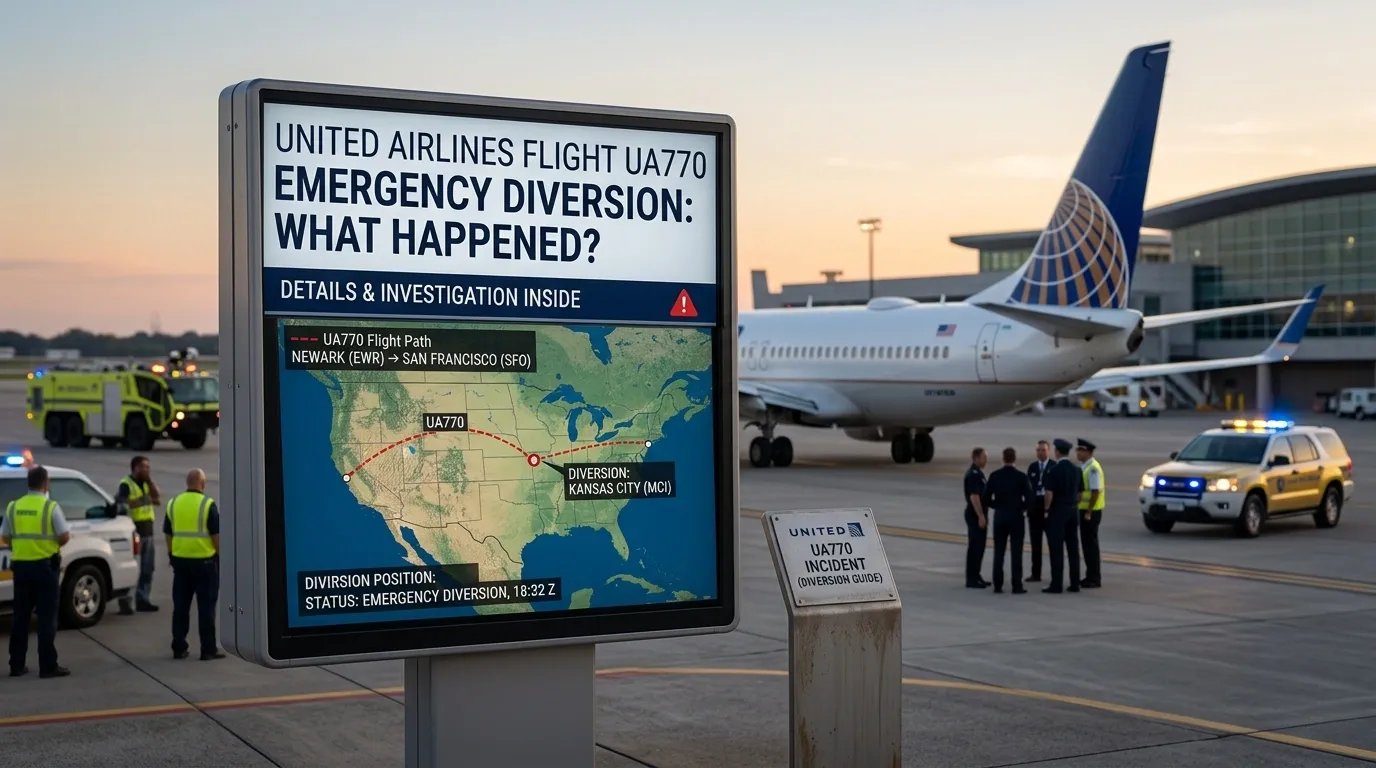
The situation was quite normal for the passengers on United Airlines Flight UA770. It was a routine flight that people use in Spain to travel to the United States of America. Instead, the flight drew attention after an unexpected mid-air alert forced the crew to change course and land earlier than planned.
The incident, now widely discussed online, raised questions about what happened during the flight and why pilots decided to divert the aircraft. Fortunately, the situation ended safely, but it offers a useful look into how airlines handle unexpected technical issues in the air.
A Routine Flight That Took an Unexpected Turn
United Airlines Flight UA770 was scheduled to travel from Barcelona–El Prat Airport in Spain to Chicago O’Hare International Airport in the United States. It was a Boeing 787-9 Dreamliner, and the airline was using it because it is one of the best long-range jets of airlines to use for transatlantic routes.
Not long after departure, the flight appeared to be progressing normally. However, while cruising at altitude, the flight crew noticed a cockpit warning indicator.
Although such alerts are not always dangerous, pilots are trained to treat them seriously. Aviation procedures require crews to evaluate the issue immediately and decide whether to continue the flight.
The Moment the Crew Declared an Emergency
As the flight continued across European airspace, the cockpit crew received an alert connected to one of the aircraft systems, believed to involve cabin pressurization or environmental controls.
The cabins in the aircraft maintain proper pressure. It is because at the altitudes these planes fly, it can be difficult for passengers to breathe comfortably.
We must remember that the aircraft were designed. Even the smallest irregularity can trigger warnings, and cockpit staff are expected to respond immediately. The staff immediately reviews the emergency checklists and decides the alerts accordingly. Once it is done, the pilots develop a connection with air traffic control. It helps them discuss the emergency level and make decisions accordingly.
This step allowed the aircraft to receive priority handling from controllers and cleared the way for a diversion if necessary.
Why the Aircraft Diverted to London
The aircraft was going to Chicago. During the trip, it had to cross the Atlantic as well. The crew decided to avoid it for the safety of the aircraft, passengers, and crew. It diverted to London Heathrow Airport, one of the world’s busiest and most famous airports. The diversion was also decided at this airport because it is well equipped with the latest safety and emergency-handling tools and technologies in the world.
Many factors are involved in deciding on this option. We have mentioned a few below:
- Heathrow has long runways. It means wide-body aircraft can be landed without any hurdles.
- The airport has quick emergency response teams available round the clock.
- The maintenance crews have the best and fastest inspection facilities in the world.
- This airport is the best diversion point for the flights crossing the Atlantic.
The aircraft began moving to London within minutes.
Safe Landing and Passenger Assistance
United Airlines Flight UA770 landed safely at Heathrow Airport. All emergency units were activated and deployed to deal with any emergency. These teams were on standby to address any critical situation.
Thankfully, everyone on board was safe.
The aircraft landed safely. The airline staff helped passengers gather at the gate. Generally, in these situations, good airlines ensure that travelers reach their destination without delay.
Support may include:
- Rebooking passengers on alternative flights
- Providing meal vouchers or accommodation if needed
- Offering customer support for travel arrangements
Although delays are frustrating for travelers, safety always comes first in aviation decisions.
What Is “Squawk 7700”?
It is a special signal designed for pilots to deal with emergencies.
During emergencies, pilots may activate a special signal known as “Squawk 7700.”
This transponder code alerts air traffic control that an aircraft is experiencing an emergency. Once the signal is transmitted, controllers immediately give the aircraft priority and coordinate with nearby airports.
Why Flight Diversions Sometimes Happen
Emergency diversions may sound alarming. However, it is not an emergency all the time. Generally, diversions are quite normal in aviation safety procedures. We can observe this quite easily, as accidents or emergencies occur less than 1% of the time, compared with diversions.
Pilots may decide to divert a flight for several reasons, including:
- Mechanical alerts are designed within aircraft systems.
- Pressure irregularities in the aircraft cabins could cause discomfort for passengers.
- Some medical emergencies can be dangerous for a specific passenger.
- Some weather conditions may be severe, and aircraft may face a critical situation during them.
- Some unusual cockpit warnings that demand emergency action.
Mainly, precautions are the main reason for diversions. most common. Modern aircraft are designed to detect even small irregularities, allowing crews to respond early before problems become serious.
Aviation Safety Systems in Action
The process of aviation safety operations is quite efficient and effective, and mainly, the efforts of these operations are not visible to many. The same situation occurred with the United Airlines Flight UA770 incident. However, many people consider it a notable exception.
It is essential to remember that modern commercial aircraft have the most sophisticated monitoring systems. These systems continuously monitor cabin pressure, engine performance, and environmental conditions. When something extraordinary happens, the cockpits receive instant alerts.
At the same time, pilots undergo extensive training to handle these situations calmly and methodically. Air traffic controllers and airline operations teams on the ground support their decisions.
When these layers work together, commercial aviation becomes the most advanced and safest form of transportation.
Final Thoughts
The United Airlines Flight UA770 emergency diversion raised concerns among passengers onboard. However, when discussing the outcome, we learn that aviation safety procedures are highly effective and efficient at ensuring the security of aviation traffic.
Once the cockpit alert appeared, the crew followed established protocols, communicated with air traffic control, and safely diverted the aircraft to a nearby airport.
Modern aviation safety is the top priority for aviation authorities. The situation, as we discussed above, confirms it and means changing course mid-flight.
Frequently Asked Questions
What caused the United Airlines Flight UA770 emergency diversion?
A cockpit alert made the flight crew attentive. This alert concerned about a technical issue that prompted the crew to divert—the technical alert concerned cabin pressurization.
Where did the flight land after diverting?
The authorities rerouted the airline, and it landed safely at London Heathrow Airport.
Were passengers injured during the incident?
There were no injuries. All passengers and crew members were safe.
What aircraft was operating Flight UA770?
Boeing 787-9 Dreamliner operates this flight. It is one of the most modern aircraft, with many international airlines using it on long-haul routes.
Why do airlines divert flights during technical alerts?
Safety is the main reason why airlines divert their flights. In this process, even minor warnings are not ignored to avoid potential risks to passengers and crews.
