


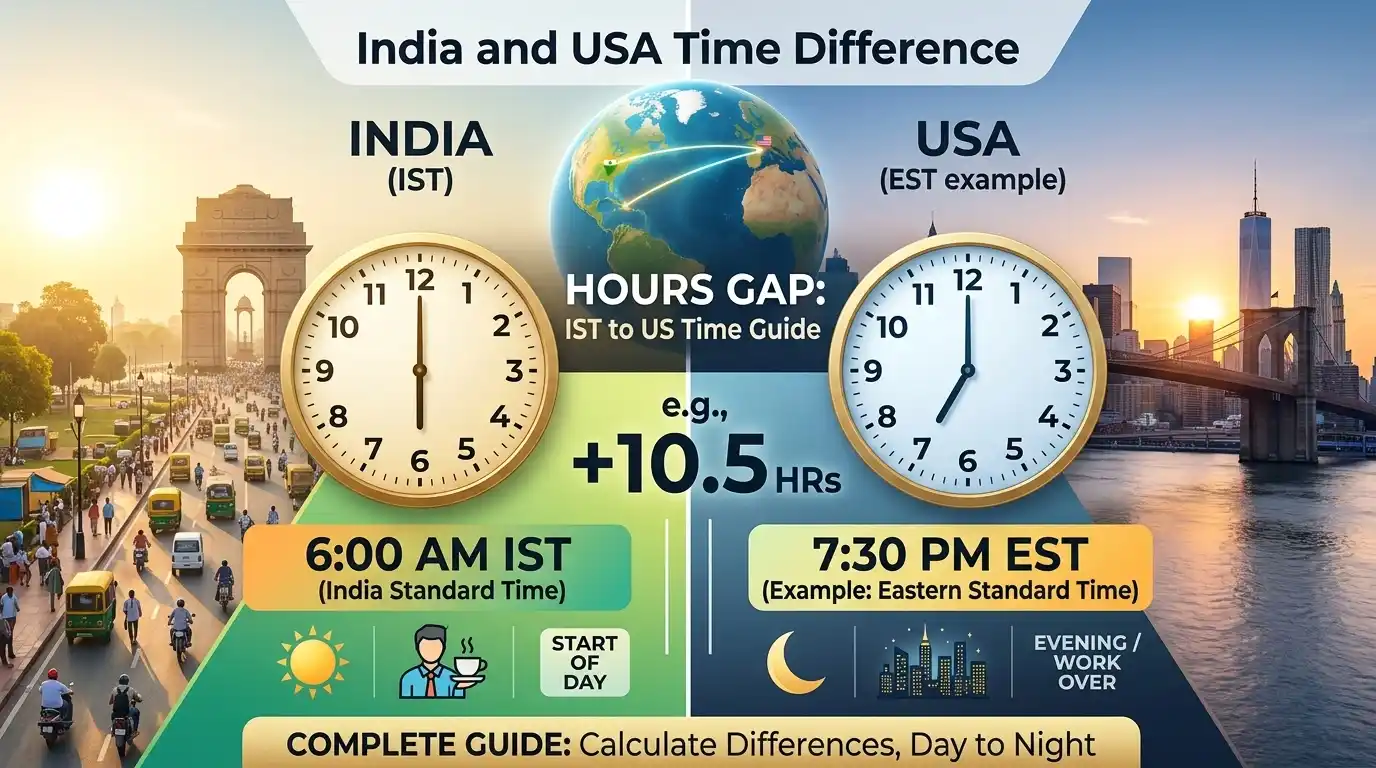
The time difference between two countries matters most when business deals are underway; friends live in those countries, or someone is trying to build a community in a specific region. Keeping the India and USA time difference in mind is essential not only for the reasons given above but also for international communication, remote work, business meetings, and travel planning. Because the United States spans multiple time zones while India uses only one, the time difference between the United States of America and India varies. This difference largely depends on the regions in the United States.
In this guide, you will learn how Indian Standard Time (IST) compares with the major U.S. time zones, how Daylight Saving Time affects the difference, and how to convert time between India and the United States easily.
What Is the Time Zone of India?
India uses a single time zone. Therefore, when exploring, we get Indian Standard Time (IST) unchanged. It is because there is no concept of daylight saving time here.
- Time Zone: UTC +5:30
- Applies to: Entire country
- Daylight Saving Time: Not observed
IST remains constant throughout the year because India does not adjust clocks seasonally.
It confirms that the time difference between India and specific US regions varies only because of the difference between standard time and daylight saving time (DST).
Time Zones in the United States
As we have already discussed, the United States of America has various time zones. The most specific reason for these differences is the country’s geographic size. If it is not done, people may suffer greatly due to the difference between days and nights.
Unlike India, the United States has multiple time zones due to its large geographical size.
The six primary US time zones are:
- Eastern Standard Time (EST): UTC -5
- Central Standard Time (CST): UTC -6
- Mountain Standard Time (MST): UTC -7
- Pacific Standard Time (PST): UTC -8
- Alaska Standard Time (AKST): UTC -9
- Hawaii Standard Time (HST): UTC -10
Most American states also observe Daylight Saving Time (DST), which shifts clocks forward by one hour in spring and back in fall.
India and USA Time Difference (Quick Table)
As we already know, India uses UTC+5:30, and it does not change; the time difference depends on the specific US time zone.
| US Time Zone | Time Differences from India |
| Eastern Time (EST) | India is 10 hours 30 minutes ahead |
| Central Time (CST) | India is 11 hours 30 minutes ahead |
| Mountain Time (MST) | India is 12 hours 30 minutes ahead |
| Pacific Time (PST) | India is 13 hours 30 minutes ahead |
| Alaska Time | India is 14 hours 30 minutes ahead |
| Hawaii Time | India is 15 hours 30 minutes ahead |
Example:
If it is 8:00 AM in New York (EST)
It will be 6:30 PM in India (IST).
India vs USA Time Difference During Daylight Saving Time
The United States observes Daylight Saving Time (DST) between March and November.
During DST:
- US clocks move 1 hour forward
- The time difference between India and the US becomes 1 hour smaller
Example with New York:
| Period | Time Difference |
| Standard Time | India is 10.5 hours ahead |
| Daylight Saving Time | India is 9.5 hours ahead |
This change occurs because India keeps the same time year-round.
Examples of India to USA Time Conversion
Here are some simple examples.
Example 1
10:00 AM in India (IST)
US City Local Time
New York: 11:30 PM (previous day)
Chicago: 10:30 PM (previous day)
Denver: 9:30 PM (previous day)
Los Angeles: 8:30 PM (previous day)
Example 2
7:00 PM in India
US City Local Time
New York: 8:30 AM
Chicago: 7:30 AM
Denver: 6:30 AM
Los Angeles: 5:30 AM
Why the Time Difference Between India and the USA Is So Large
The main reason is the geographical distance between the two countries.
Key factors include:
1. Longitude Differences
The Earth rotates 360° every 24 hours. Countries located far apart have large time differences.
2. Multiple Time Zones in the USA
When exploring the US map, we find large distances between cities, which require multiple time zones.
3. Single Time Zone in India
India chose to maintain one standard zone for administrative convenience across the country.
Best Time for Meetings Between India and the USA
Because of the large time difference, scheduling meetings can be challenging.
Here are some good overlap windows:
| India Time | US Eastern Time |
| 6:00 PM IST | 7:30 AM EST |
| 7:00 PM IST | 8:30 AM EST |
| 7:00 PM IST | 9:30 AM EST |
These times are commonly used for:
- Remote work
- IT services
- International business calls
- Customer support teams
How to Quickly Convert India Time to USA Time
Here are some steps we have identified for your convenience:
- Identify the US time zone (EST, CST, PST, etc.).
- Subtract the time difference from IST.
- Adjust for Daylight Saving Time if necessary.
Alternatively, US professionals use online time converters or calendar apps to schedule international meetings.
FAQs
What is the time difference between India and the USA?
Many answers can be given here. Overall, the time difference ranges from 10 hours, 30 minutes to 15 hours, 30 minutes. Moreover, it depends on the time zone in the US.
Is India ahead of the USA in time?
Yes. India is ahead of all US time zones.
Does India use Daylight Saving Time?
No. Daylight saving time is not in India. For the entire year, Indian Standard Time (IST) remains constant.
Why does the USA have multiple time zones, but India has one?
The United States uses multiple time zones due to its large geographic size, while India chose a single national time zone for administrative simplicity.
Conclusion
The India and USA time difference varies depending on which US time zone you are comparing with. In general:
- When identifying the difference between Indian Standard Time and Eastern Time, India is 10.5 hours ahead.
- India is 11.5 hours ahead of Central Time when identified.
- India is 13.5 hours ahead of Pacific Time.
Because the United States uses Daylight Saving Time, the difference can change by one hour during certain months.
Understanding this time difference is crucial for international collaboration, business communication, remote jobs, and global travel planning.
