


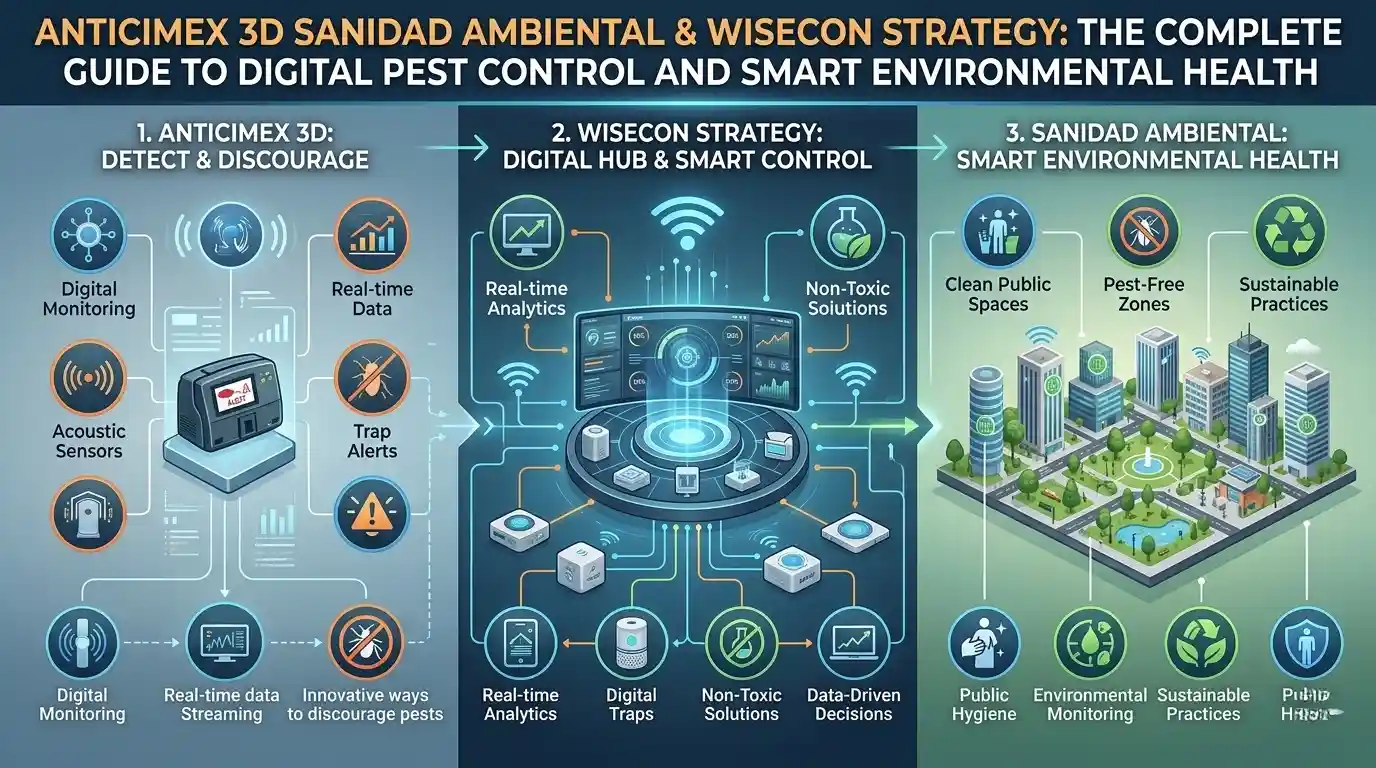
Maybe you are interested in knowing anticimex 3D sanidad ambiental wisecon estrategia.” Is it so? Well, you may have multiple articles about it. However, almost all are trying to give repeated, surface-level ideas. For example, these guides discuss dashboards, prevention, sustainability, and IoT sensors a lot.
Our guide goes further.
You’ll learn what the model really means in practice, how WiseCon’s platform strategy (estrategia de plataforma / estrategia de consolidación) connects to Anticimex’s digitally enabled approach, and how to evaluate (or implement) a smart pest monitoring and environmental health monitoring program that’s measurable, auditable, and built for multi-site operations.
Quick Answers
- What is the strategy? It is not only about pest control. The shift is to a digital pest control platform. The advantage of using this platform is that it is built on connected devices, standardized reporting, and real-time pest monitoring. In simple terms, it works in real time rather than waiting for a fixed schedule.
- What’s the “platform” part? You have a centralized system (devices → data hub → dashboards → workflows). Now, you can predict pest management and repeat it across sites.
- Why does it matter? Infestations can be reduced tremendously. Moreover, you can improve sanitation compliance. The story does not end here, as you can support sustainable pest control through non-toxic monitoring and response.
What is Anticimex 3D Sanidad Ambiental?
Anticimex 3D Sanidad Ambiental, S.A. is listed by Anticimex as its office/entity for Spain.
In practical terms, “sanidad ambiental” refers to environmental hygiene, the mix of pest management, sanitation risk control, documentation, and operational safety that industries such as food, healthcare, hospitality, and logistics depend on.
When people search for this topic, they usually want one of these answers:
- A simple explanation of how digital pest control works
- A business explanation of why the “WiseCon strategy” is discussed as a consolidation/platform strategy
- An implementation view (What devices, dashboards, data, SOPs, and audits look like.)
WiseCon and the “estrategia de plataforma” (and why “consolidación” is part of the conversation)
You will find many pages that use Spanish phrasing. For example:
- WiseCon estrategia de plataforma
- WiseCon estrategia de consolidación
Here’s the clean way to understand it:
What is the strategy behind?
Pest control consists of isolated visits. However, we are living in an era of “platform strategy”. No more isolated visits are required, as everything is connected. You have standard hardware, standard data, and standard workflows, all connected to a system. Now, you can scale your services city-by-city, region-by-region, and multi-site business-wise.
Why WiseCon gets mentioned
Anticimex announced it acquired the remaining shares in WiseCon in 2017, following an earlier stake in 2015, and described WiseCon’s technology as a foundation for its SMART concept and as an innovation center for digital pest control.
That’s why competitors keep tying WiseCon to “consolidation”: consolidation is what happens when a group standardizes technology, reporting, and operating procedures across branches—so customers experience the same digital monitoring, the same documentation, and the same response logic wherever they operate.
The big shift: from reactive pest control to digitally enabled prevention
We can easily identify traditional pest control. It often looks like this:
- Scheduled inspections (monthly/quarterly)
- Manual checks for activity
- Reactive treatments after evidence is found
Digitally enabled pest control replaces that with:
- IoT pest monitoring systems and connected traps
- 24/7 surveillance
- alerts based on activity
- action based on risk signals, not guesswork
Anticimex describes SMART as protecting businesses 24/7 with constant monitoring and fast response, combining automation with professional service.
Traditional vs Digital Pest Control (table for snippets)
CategoryTraditional pest controlDigital pest control (SMART-style)
Timing Fixed schedule visits Continuous monitoring + activity-driven response
Visibility Limited to inspection moments Real-time pest monitoring (always-on signals)
Methods Often treatment-heavy Non-toxic pest control options + targeted actions
Documentation Manual logs, inconsistent Data export + consistent reporting via hub/dashboard
Outcomes Harder to measure KPIs, trend analysis, predictive prevention
The “3D” model explained
Many competitor articles summarize “3D” as Detect, Decide, Defend. Whether you call it a model, a framework, or an operating loop, it’s useful because it maps perfectly to how a digital sanitation system should work.
1) Detect (Detección)
Goal: identify activity early, especially in “blind spots.”
- There are smart traps.
- There may be motion/heat sensors.
- Entry-point monitoring is also essential.
- You may have high-risk zone coverage (waste areas, loading bays, kitchens, storage)
This is where IoT pest detection and smart pest monitoring matter most, because what you don’t detect becomes an infestation.
2) Decide (Decisión basada en datos)
Goal: turn signals into decisions.
- Trend lines over time
- Identifying heatmaps by zone
- Seasonal patterns must also be observed.
- Correlation with humidity/temperature or operations (where applicable) also matters in this regard.
This is the “intelligence layer”: predictive pest management happens when the system can distinguish noise from real risk and prioritize action.
3) Defend (Defensa / intervención)
Goal: respond precisely.
- Targeted service visits
- Trap relocation to hotspots
- Proof-of-action documentation
- Prevention improvements (sealing, waste controls, hygiene changes)
Anticimex’s SMART approach emphasizes solving root causes and continuous monitoring and response to prevent costly damage.
How a WiseCon-style platform strategy works in real life (system view)
A strong “WiseCon estrategia de plataforma” article should explain the end-to-end system, not just buzzwords.
The operating loop (simple but complete)
- Assess risk & plan the network.
- Anticimex describes starting with inspection, documentation review, and interviews to design the right solution.
- Install and connect devices.
- A system of strategically placed sensors and non-toxic traps is installed, connected, and reporting back to a data hub.
- Monitor continuously, act when needed.
- The service team performs inspections and maintenance, analyzes data, and responds quickly when activity is reported.
The Platform Components
When choosing a platform, you must understand that multiple things, activities, and techniques are involved. We have mentioned all of them separately below:
- Devices: connected traps, sensors, monitors (rodent and fly monitoring are commonly discussed in digital models)
- Connectivity: device-to-hub reporting, alerting (site-wide visibility)
- Data hub: The experts call it a central “smart data hub”. It consists of aggregation and storage.
- Dashboards: You can keep an eye on multi-site comparisons, trend views, audit exports, and more.
- Workflows: who gets notified, how quickly, and what “resolved” means
- Reporting: sanitation compliance, client reporting, audit readiness
This is what turns pest control into a digital pest control platform rather than a set of tools.
Why this approach can rank for “sustainable pest control” and “eco-friendly pest management.”
A major ranking advantage is linking pest control to sustainability in a credible way, without over-claiming.
Anticimex describes SMART as:
- Preventing infestations “in an environmentally-friendly way.”
- Using and utilizing to ensure there are 100% non-toxic traps in the SMART system
- Enabling targeted action with minimal or no pesticides in digital pest control contexts
Sustainability Angles to Cover
- Reduced pesticide exposure risk
- Precision interventions
- Lower waste
- Audit and documentation
Key Benefits
1) Real-Time Pest Monitoring (24/7)
It simply means continuous surveillance. In its presence, you can easily identify problems before they escalate, so periodic visits can be converted into real-time monitoring.
SMART describes non-toxic traps and highlights healthier work environments by avoiding pesticides where they don’t belong.
2) Predictive Pest Management
Predictive doesn’t have to mean “AI hype.” It can mean:
- Trend detection
- Risk scoring
- Escalation rules
- Seasonal planning
3) Easier Documentation and Sanitation Compliance
Anticimex highlights “easy documentation” and data export via the smart data hub, both of which are useful for audits and external reporting.
4) Lower Total Risk
Even one incident in regulated industries can mean:
- Product loss
- Audit nonconformance
- Reputational damage
- Downtime
Digital prevention focuses on avoiding costly escalation.
Implementation Blueprint
Step 1: Site risk assessment (the foundation)
Map:
- Entry points
- Sources (Food and Water)
- Harborage zones
- Waste flows
- Historical incident data
Anticimex consists of a few steps, including inspection, review, and interviews.
Step 2: Network Design
Decide:
- Where sensors/traps go
- What “alarm thresholds” are
- What counts as “resolved.”
- Escalation paths
Step 3: Installation + Connectivity
This step has a few substeps. First, we need to install devices. Second, reliable reporting to the hub will be ensured. Anticimex describes connected sensors and traps reporting back to a smart data hub.
Step 4: Response Playbook
Define SLAs by risk level:
- Critical zones: Immediate action window
- Standard zones: Scheduled response window
- Trend alerts: Preventive inspections and trap relocation
Step 5: Reporting and Audit Package
Another important step is to create a repeatable export/report set. It will consist of:
- Activity summaries by zone
- Trend charts month-over-month
- Corrective actions log
- Preventive recommendations
Anticimex points to exporting data for external parties and supporting compliance.
KPI Dashboard: What to Measure?
These systems also offer KPIs to monitor performance at multiple levels. These KPIs help service buyers care about and measure.
Operational KPIs
- Time-to-alert
- Time-to-response
- Repeat-activity rate
- Hotspot concentration
Risk KPIs
These KPIs are designed to avoid risks.
- Incidents prevented
- High-risk zone stability
- Seasonal risk forecast accuracy to ensure you are protected when there is a spike.
Compliance KPIs
The following aspects are covered under these KPIS
- Audit readiness score (report completeness)
- Documentation turnaround time
- Corrective action closure rate
These terms naturally reinforce data-driven pest prevention, compliance monitoring, and predictive pest management without forcing keyword stuffing.
Challenges, Restraints, Limitations, and Considerations
A truly high-ranking guide must inform the readers about acknowledged constraints. We identified the maximum to help you make an informed decision.
Connectivity & Resilience
- You must be aware of what happens if connectivity drops.
- It is essential to learn, “Does the system buffer events and sync later?”
- Do you have fallback procedures for critical zones?
Data Governance
- Who owns the data?
- How long is it retained?
- Who can access dashboards?
Change Management
Switching from “scheduled visits” to “signal-based response” requires training:
- Staff education
- Customer expectations (fewer routine visits doesn’t mean less protection—if monitoring is continuous)
- SOP updates
Upfront Investment vs Lifecycle Savings
Digital monitoring can require upfront device/network setup. Your ROI argument should focus on:
- reduced infestation risk
- reduced product loss
- fewer emergency interventions
- stronger compliance posture
This is how you build a topical cluster around smart pest control technology and environmental health monitoring, and it’s where thin competitor pages typically fail.
Conclusion: Why “Anticimex 3D Sanidad Ambiental Wisecon Estrategia”?
At its core, Anticimex 3D Sanidad Ambiental Wisecon Estrategia describes a modern service model:
- Continuous monitoring
- Data-driven decision-making
- Targeted interventions
- Consistent documentation
- A scalable platform that supports multi-site operations
Anticimex’s SMART approach is positioned around 24/7 prevention, connected sensors, and non-toxic traps reporting to a data hub, fast response, and easy documentation, exactly the combination that makes digital pest control measurable and auditable.
And Anticimex has explicitly connected WiseCon technology to SMART and its broader digital pest control strategy.
FAQs
What is Anticimex 3D Sanidad Ambiental?
Anticimex 3D Sanidad Ambiental is the Anticimex office/entity for Spain, specializing in environmental hygiene and pest control services.
What does “WiseCon estrategia de plataforma” mean?
It refers to a platform approach in which connected devices, centralized data, dashboards, and standardized workflows turn pest management into a continuous, measurable system rather than an occasional visit.
What is “WiseCon estrategia de consolidación”?
It’s commonly used to describe standardizing technology and operations across branches—consolidating tools, reporting, and methods so service delivery scales and stays consistent.
How does digital pest control work?
A typical flow is: assess and plan → install connected sensors/traps → continuous monitoring → alerts → targeted response → reporting and documentation.
Is Anticimex SMART non-toxic?
Anticimex describes SMART traps as non-toxic and positions the system as environmentally friendly, with continuous monitoring and quick response.
How does digital monitoring help with audits?
Digital systems can export activity and intervention data through the hub/dashboard for external reporting and audit documentation, reducing manual paperwork.
Which industries benefit most from smart pest monitoring?
Food and beverage, healthcare, hospitality, logistics/warehousing, and municipal infrastructure benefit from strict hygiene requirements, complex sites, or high reputational risk.
Why is WiseCon connected to Anticimex?
Anticimex announced it had acquired WiseCon and described WiseCon’s technology as the basis for its SMART concept and as an innovation center for digital pest control.
